
How to Find Cleveland County Arrest Records
The fastest first stop is the Sheriff's jail roster. It lists people held in the Cleveland County Detention Center right now and shows the name, booking details, and hold reasons. The Sheriff's Records Division keeps the original arrest reports, citations, and collision reports. The court case, if charges are filed, sits on OSCN. Each source answers a different question.
Use these steps to trace an arrest.
- Search the Cleveland County inmate roster for a current booking.
- Request an arrest or incident report from the Sheriff's Records Division.
- Check OSCN for a filed criminal case and its charges.
- Read the count-level disposition to see the outcome, if any.
- For sentenced state custody, use the Oklahoma DOC offender lookup.
For the full custody tool, see inmate records. For filed charges and dockets, see court records.
Recent Cleveland County Arrests
People often want recent bookings, not old cases. The jail roster is the closest thing to a live arrest list for Cleveland County. It shows people currently held, with a name, an arrest date, and the reasons for the hold. Because it focuses on current inmates, it is a snapshot. A person arrested and released the same day on bond may not stay on the list long.
The roster is run through the Sheriff's public portal. It is free and searchable by name. For an arrest that did not lead to a jail stay, such as a cite-and-release, the better source is the Sheriff's Records Division report rather than the roster. And for the formal charge, watch for a filed case on OSCN, which can post days after the arrest.
Booking activity rises and falls. A count you see today is not a trend, and one name on the roster is not the whole picture of a person's history.
Arrest Records Versus Criminal Court Records
An arrest record and a criminal court record are not the same file. The arrest record is a law-enforcement record about a booking. The court record is the case that may follow. One can exist without the other.
| Feature | Arrest Record | Criminal Court Record |
|---|---|---|
| Who keeps it | Sheriff's Office / Detention Center | District Court Clerk on OSCN |
| What it shows | Booking, hold reasons, arrest report | Charges, pleas, disposition, sentence |
| Where to look | Jail roster and Sheriff's Records | OSCN Cleveland County docket search |
| Proves guilt? | No | Only a conviction does |
For the filed-case side, the Cleveland County court records page walks through the docket.
Mugshots and Booking Information
The jail roster can show a booking photo when one is part of a public record. The Cleveland County portal lists fields such as mugshot, name, date of birth, arrest date, and hold reasons. A second detail row can show the reasons a person is held. Juvenile information is restricted by the portal settings.
A mugshot does not prove a charge or a conviction. It marks a booking event. Treat it that way. The roster focuses on current inmates, so a person released on bond or transferred may drop off the list even though a court case continues. For booking-to-court flow, see inmate records.
Booking data also has gaps. The portal shows what the jail configured for public view, and some fields stay blank on a given record. A booking is a custody event, so it does not include the charges as a court would phrase them. For the charged counts and the cited statutes, read the OSCN case once it is filed.
Charges Versus Convictions
A charge is an accusation. A conviction is a court finding of guilt or a guilty or no-contest plea accepted by the court. Reading them as the same thing leads to errors. Many charges end in dismissal, reduction, or a deferred result.
| Point | Charge | Conviction |
|---|---|---|
| Stage | Filed accusation | Final outcome |
| Where it shows | Arrest report and case counts | Count-level disposition |
| Meaning | Alleged, not proven | Proven or admitted in court |
To confirm an outcome, read the disposition on the OSCN docket, not the arrest entry. The court dockets page explains how.
The Sheriff's Records Division
The Sheriff's Records Division keeps original reports filed by deputies. That includes arrests, citations, warnings, collision reports, and detention-center reports. Two clerks process these records and send required reports to state and federal agencies. A report copy costs $5, and it is free to a crime victim.
The division also runs a county background check against the Sheriff's Office records database for $5. People use it for a Self-Defense Act weapons-carry license, a CLEET certificate, a job, military recruiting, an adoption, or a real-estate license. This check searches only county sheriff records, so it is narrower than a statewide criminal history.
Keep the limits in mind. A county check covers what the Sheriff's Office has on file, not cases from other counties, other states, or the federal courts. A full background history may need a state-level search and a court-record check on OSCN. For a court outcome, the docket is the source of truth, while the sheriff report covers the arrest and the law-enforcement contact.
Sheriff's Records Division
2600 W. Franklin Road
Norman, OK 73069-8012
405-701-8888
Mon-Fri, 8:00 a.m. to 5:00 p.m.
Oklahoma State Criminal Records
After a state conviction and prison sentence, custody and supervision data move to the Oklahoma Department of Corrections. The DOC offender lookup shows state-custody status when it is available. People held only in the county jail before trial may never appear in DOC records, so use the right tool for the stage of the case.
The Oklahoma DOC offender information page links the state offender lookup.
The page also explains open-records limits and points to the separate Pardon and Parole Board for clemency and parole questions.
Oklahoma Sex Offender Registry
The Oklahoma Sex Offender Registry lists people who must register under the Sex Offenders Registration Act in Title 57. You must acknowledge a disclaimer before you search. The registry lets you search by name, county, city, crime, appearance, zip code, or address radius, and you can sign up for a community notification when a registrant moves near an address.
Start at the Oklahoma Sex Offender Registry entry page.
After the disclaimer, the public search page opens the full set of filters for Cleveland County and statewide results.
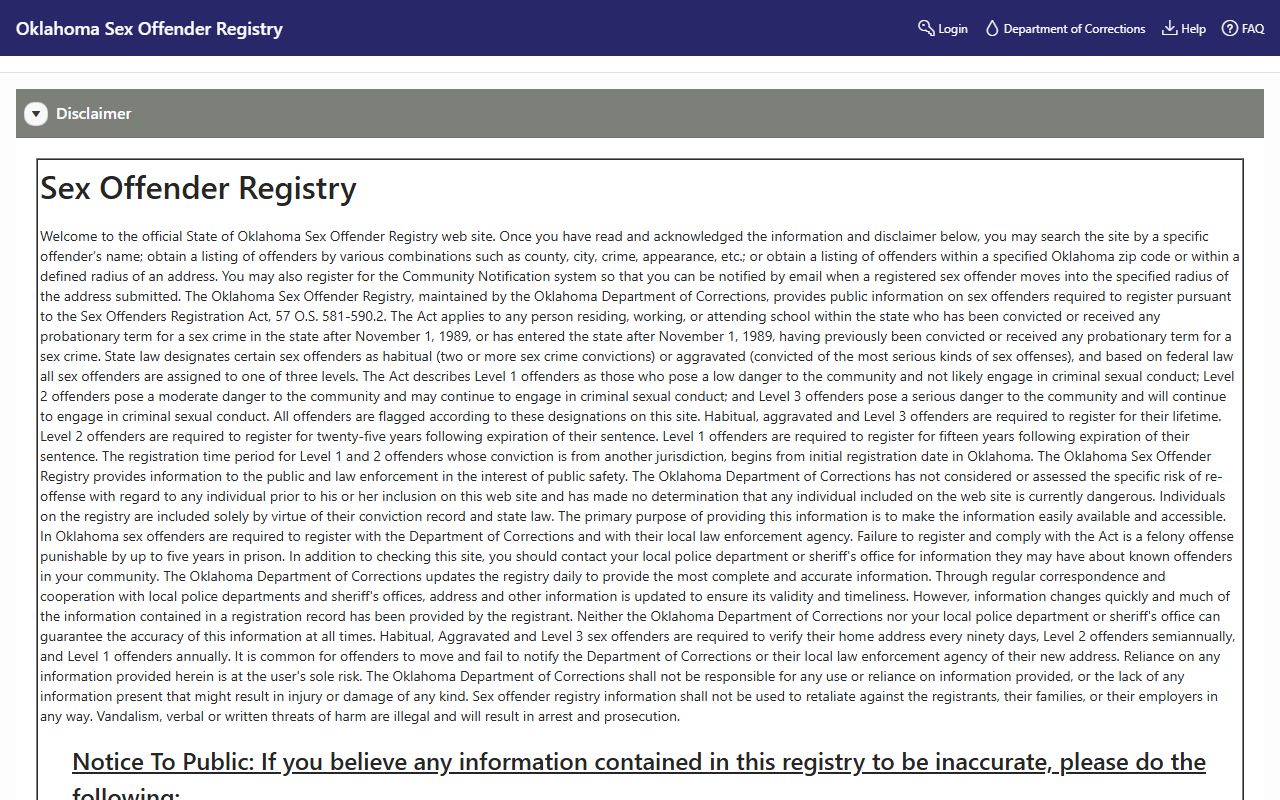
Registry status depends on the conviction and the law, not on a release from the county jail. It is separate from an ordinary arrest or custody record.
Federal Inmate and Offender Locators
Some Cleveland County cases move to federal court. For a person in federal custody, the Bureau of Prisons inmate locator is the right tool. The U.S. Department of Justice also gathers locator links for prisons, inmates, and sex offenders in one place.
The Justice Department locator page points to the federal tools.
A Cleveland County arrest on state charges does not create a federal record unless federal custody exists. Federal cases from this area are handled in the U.S. District Court for the Western District of Oklahoma, and those dockets sit on the federal PACER system, not on OSCN. For released-custody tools, see released inmates.
Sealed and Expunged Records
Oklahoma lets some people seal or expunge a criminal record under 22 O.S. sections 18 and 19. Sealing and expungement are close but not identical, and neither one simply deletes a record.
| Point | Sealed Record | Expunged Record |
|---|---|---|
| What happens | Public access is closed by order | Court and arrest records are sealed under the statute |
| Who can still see it | Limited authorized parties | Certain criminal-justice agencies |
| How to get it | Court order or statute | Petition under 22 O.S. 18 and 19 |
A person files a petition in the District Court, notifies the affected agencies, and asks the judge to seal the record if the criteria are met. For help, see self-help and legal aid.
DUI, DWI, and Serious Traffic Arrests
Not every traffic stop ends with a simple ticket. A DUI, a DWI, driving under suspension, eluding, or leaving the scene can lead to an arrest and a criminal case. When that happens, the matter shows up as a criminal docket on OSCN, not just a traffic citation. A booking for one of these offenses lands on the jail roster like any other arrest.
That overlap matters for a search. If you cannot find a serious traffic matter under traffic citations, check the criminal case types instead. A single stop can also create more than one record, including the arrest report, the court case, and a hit on the state driver record. The traffic court records page sorts out which file holds what.
Restricted Juvenile and Youthful Records
Juvenile records are limited under Title 10A. The jail portal and OSCN both restrict juvenile details. A youthful offender case can carry its own access rules. Absence from the public jail search is not proof that no custody event ever happened.
Note: Do not treat a public arrest entry as a full criminal history, since sealed, juvenile, and out-of-county matters may not appear in any single search.
For DUI and DWI matters that overlap traffic, see traffic court records. For active warrants, see warrant records.